
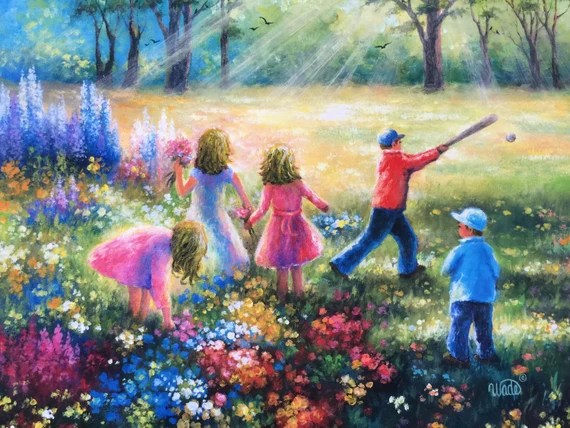
Image by Vickie Wade Fine Art
One thing I often hear from other parents is how frustrated and helpless they feel over their children fighting with each other. It is like some mystery they cannot solve and escape from. I understand this very well, as it was once my experience too.
There are many different reasons why children fight with each other, and some may be unexplainable. I want to share what I have learned about fighting through my own parenting experience and seeing what does and doesn’t work. In my book: Free Flowing Family: A Journey of Unschooling through Awakening and Healing, I share a whole chapter about the long battle of fighting I faced with my own children and how it taught me to heal my own anger. The chapter is titled: Creating a safe space for fighting.
You might be wondering why on earth I would want to “create” a space for fighting rather than stop it. Well, I did try to stop it, for a long time, with no success! The only option I had left was to turn towards my own feelings and begin to understand myself in a deeper way.
The first time I noticed a change in my children’s fighting was when I decided to homeschool. People might think that their children being at home together all day every day will create more fighting, but for me it was the opposite. Sure, I hear parents say that their children fight all weekend because they are together all day for two days, or in the school holidays when they are together for weeks, and I can understand this. However, as the weeks went on and my children “deschooled” the fighting tapered off.
Deschooling is the process of undoing the harm that comes with going to school and having to follow a strict routine of learning things we don’t want to learn. It can take several weeks for children to adapt to the freedom of being able to learn at home in their own time and way. For my children, this didn’t take long at all, and once they settled into their new routine, free from the strict rules of school and boring homework, doing the things they enjoyed all day long, they no longer had a reason to fight.
When children are at school all day, a number of things are going on for them. For one, they don’t really want to be away from home for that long or that often. Consider us adults having to go to work for eight hours, five days a week, or going to visit people we know every day for the entire day, when all we really want to do is stay home in our pyjamas and be comfortable and relaxed. Our children are much the same. While they enjoy outings and socialising, they don’t want to all of the time; sometimes they just want to stay home and play with their toys.
Secondly, children miss their parents. It can be unsettling and even traumatic for a child to be separated from their parents before they are ready, particularly when they are in an environment that lacks love and compassion. School is not designed to teach children about the importance of expressing and healing emotion, rather children are punished and made wrong for certain feelings.
Lastly, children are sensitive beings; they can easily take on the emotions of others and learn from their peers. Having peers as the primary influence in a child’s life, which tends to happen in schools, can create many problems at home, and a child who has had to stuff down their difficult emotions all day, or has been around lots of other children with difficult emotions tends to let it all out once they are back home with their parents. They can take their frustration and feelings of separation out on their siblings.
Siblings who spend more time together in their own natural environment tend to form a stronger connection. Their primary influence is each other and their parents, and in a loving, supportive home environment fighting in minimal. Here are some other reasons children may fight:
Unhappy parents
Happy parents create happy children. There is nothing that children love more than to experience the positive energy of their happy parents. A marriage that lacks intimacy or is in constant conflict can have an affect on them and how they relate to others. Children watch how we speak to ourselves and others and learn from this. If we want them to be kind and helpful we need to show them what that looks like. This doesn’t mean we pretend to be happy with our partner if we are not. It means being honest about how we feel and what we want our life to look like. Children don’t only see us, they feel us. We may seem happy on the outside, but they can always pick up on how we are feeling on the inside. Therapy is a great way to get up close with our deeper feelings and heal our relationship blocks so we can have a more joyful, intimate marriage, even if just one of us is willing to work on ourselves.
A lack of respect
Part of demonstrating kindness to others is being kind and helpful to our children. If we aren’t listening to their needs and respecting their boundaries how can we expect them to do this with each other? They need someone to show them what respect looks like rather than someone who demands it. They do not understand what it is. They learn respect through being respected for who they are and how they truly feel. We can start to respect our children more by accepting when they say “NO” and really listening to what they are trying to say about what they need.
Suppressing emotion
Children who aren’t allowed to healthily process their emotions tend to take them out on others. When a child is freely allowed to express their feelings in the safety of a loving, attentive parent, they heal much more quickly. If not, these feelings get pushed aside and may come out in more unhealthy ways. Constant fighting is a sign of pent up anger, and anger is a cover emotion for sadness. One way to unlock the deeper feelings in our children is to rough play with them. Giving them a tackle or a tickle can first bring the anger to the surface, but if we stay with them and allow them to express it (with some boundaries of our own), they may break down and have a good cry. We can also help our children heal their suppressed emotions by starting to stay present during a meltdown or some tears. Just looking at them, holding them, or telling them “I hear you, it’s ok,” without trying to stop or change their experience is a great way to let the stuck feelings come up and be processed.
Acceptance
Any of these things we do will greatly reduce the amount our children fight, but they may still occasionally be mean to each other or fight over a toy. This is a normal part of childhood! One of the most powerful tools for healing our own emotions around our children fighting is to come into a place of acceptance around it. Seeing fighting as healthy and normal for our children and nothing to make wrong or change allows them to learn how to problem solve and form relationships. We don’t always have to work it out for them, and arguing or being frustrated with each other can be a great way for children to learn about who they are. Most of the time we try to stop our children from fighting because of our resistance to it and the belief that anger is wrong. It comes from our own suppressed emotions and not being allowed to feel angry or upset around our own parents, and this gets triggered when our children fight. The first step in accepting our children’s fighting is to accept our own feelings and allow our own pent up anger and sadness come up to be healed. Working with a therapist or an emotional healer will certainly help us to do this!
Being fed up with the constant fighting between our children is a sign that we are ready for things to change, but change can only start with ourselves. This is a blessing in disguise! Healing is knocking at our door and it’s the beginning of a more joyful, stress-free parenting experience. Nothing is set in stone forever; we can always turn things around, make things better, and have the relationships we truly desire!
Many blessings,
Leisa ❤️

 Leisa Coleman